Field work — with Ellen Pettersson
respai: the responsible-AI compass
Four months of trying to answer one honest question: what does it actually mean to use AI responsibly? Not the compliance-checkbox version. The version where you use these tools every day and you are genuinely unsure about some of what's underneath them.
The work
Together with Ellen Pettersson, we spent four months reading what regulators are actually doing, what companies are committing to (and what they are quietly not), and what "responsible" means once you move past the corporate press release.
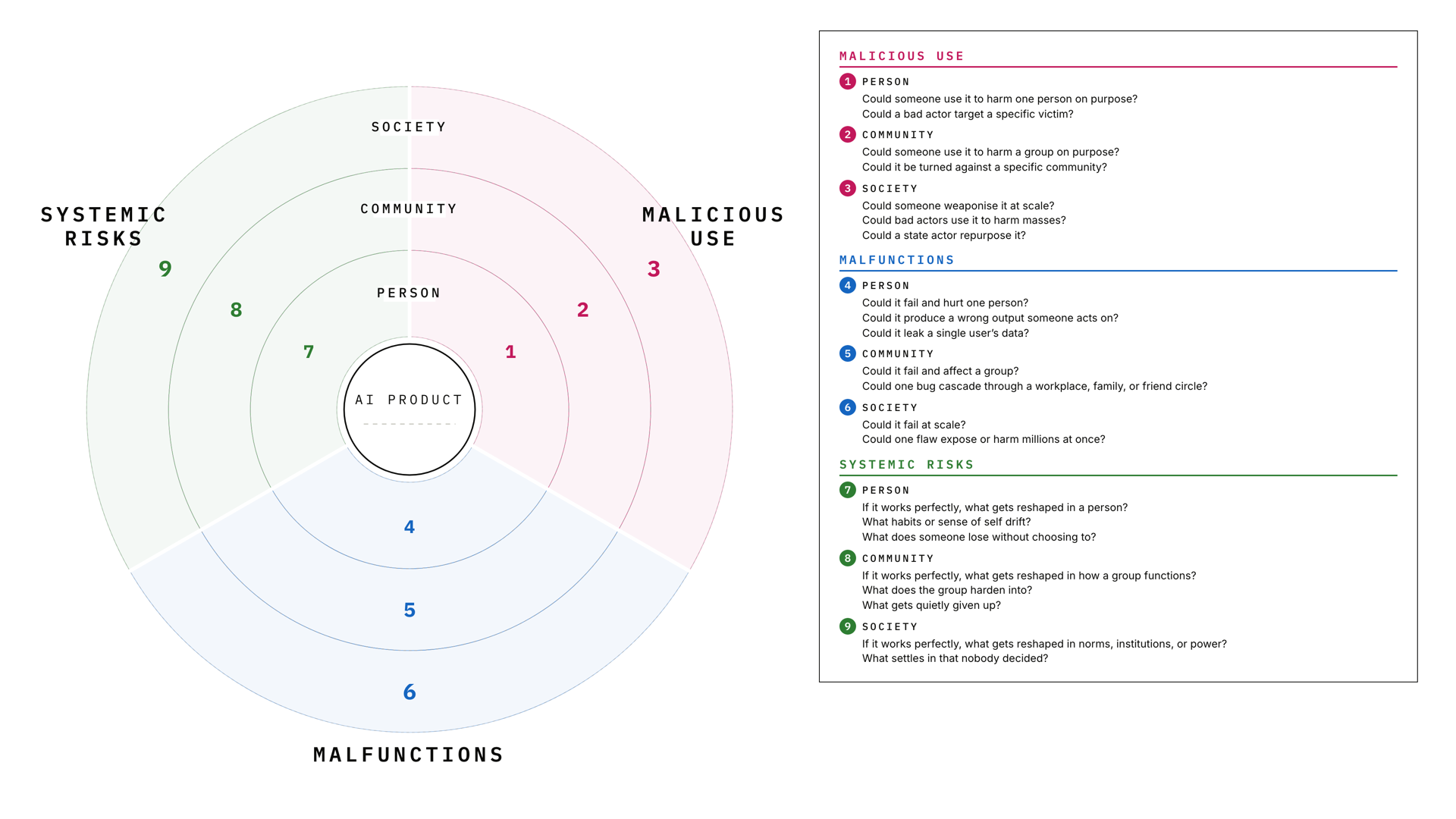
That research became two working artefacts: a landscape of the responsible-AI field, and the risk compass below. Then we did the part that matters: sat a room full of people down with them and let the framework take a beating.
Why a compass
Most AI risk conversations argue about everything at once. The compass splits one product into nine cells: three ways harm arises (malicious use, malfunctions, systemic risks, following the taxonomy of the International AI Safety Report), across three rings of who gets shaped (a person, a community, a society).
The quiet trick is the systemic row. Its prompt is "if it works perfectly, what gets reshaped?", which surfaces the risks that never look like failures.
Want to run it with your team? Download the A3 worksheets or ask us to facilitate a session.
More experiments in the next system
Back to all experiments